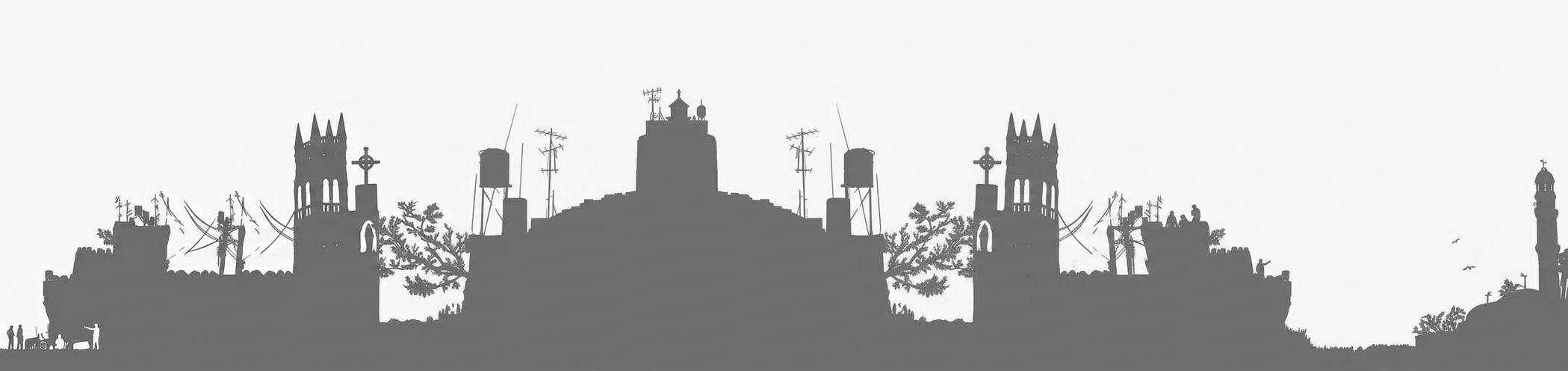
The city of Beit Jala has existed for thousands of years on a hill near the city of Bethlehem, and its Christian community is considered one of the oldest in the world. The name Beit Jala is derived from the Aramaic language and means “carpet of grass.” Anthropological evidence shows that humans lived in the Bethlehem area since prehistoric times, including as early as the Stone Age, approximately 200,000 years ago. Little is known about the city’s earliest permanent inhabitants, but it appears that the Canaanites settled there, as they did in Bethlehem, around 3000 BC. It is believed that Beit Jala may have been one of the possible locations of the ancient city of Jiloh, mentioned in Joshua 15:51 and 2 Samuel 15:12.
The earliest remains of an established Christian community date back to the Early Christian period, during the third and fourth centuries AD, when monks such as Saint Nicholas came to the area in order to be close to the birthplace of Jesus Christ. The large hill on which Beit Jala stands was considered a suitable location for building a monastery that would be close to the birthplace while remaining outside the city of Bethlehem. The Monastery of Saint Nicholas was built with the help of local residents who lived in Beit Jala. Some remains of the monastery can be seen beneath the Church of Saint Nicholas, as well as the cave where Saint Nicholas was believed to have lived. From that time onward, with the construction of the monastery, the city grew rapidly and became predominantly inhabited by Christians.
The monastery was destroyed and rebuilt several times due to changes in political rule, as the residents of Beit Jala experienced several periods of conflict and civil unrest. In 529 AD, Beit Jala and Bethlehem were captured during the Samaritan revolt led by Julianus ben Sabar. In 637, Caliph Umar conquered the entire region, including Jerusalem, and protected the Christian and Jewish communities. In 1099, the Crusaders arrived and replaced the Orthodox clergy with Catholic clergy, but they were expelled by Salah al-Din in 1187.
The Ottomans took control of Palestine in 1516 and ruled the region for four centuries. Palestinians lived relatively safe and prosperous lives during the height of Ottoman power in the sixteenth and seventeenth centuries. However, as the empire began to decline and stagnate, living conditions became increasingly difficult. The Ottoman authorities imposed heavy taxes on the population and introduced compulsory military conscription to provide soldiers for the army. In 1831, Muhammad Ali occupied the region and ruled it until 1840, when the Turks regained control with British and Austrian assistance. As a result of these upheavals, during the nineteenth and early twentieth centuries, large numbers of Palestinians—particularly residents of Beit Jala, Bethlehem, Beit Sahour, and Beit Safafa—emigrated to South America. To this day, Chile and Argentina are home to approximately 400,000 Palestinians living in the diaspora, most of whom originate from the Bethlehem area.
The Ottomans allowed European churches and institutions to enter Palestine in exchange for their assistance in defeating Muhammad Ali. British Anglican, Prussian Lutheran, French Catholic, and Russian Orthodox clergy began establishing churches, schools, and hospitals in the Holy Land. Bethlehem’s religious heritage received particular attention from missionaries, who established some of the first modern schools and churches in the region.
Between 1848 and 1900, Beit Jala witnessed the construction of two Greek Orthodox churches—the Church of Saint Nicholas and the Church of the Virgin Mary—as well as two Catholic churches, including the Latin Church of the Annunciation, and a Lutheran church, the Church of the Reformation. The first and most modern Palestinian seminary of its time, affiliated with the Latin Patriarchate, was also established, along with Cremisan Monastery. These developments played a major role in making Beit Jala home to some of the most advanced educational institutions in the country and contributed to its becoming one of the first Palestinian cities to establish a municipality, in 1912.
Following the collapse of the Ottoman Empire in 1917, the British occupied Palestine and governed it under the Mandate until 1948. During the British Mandate, Palestine went through important stages of development, including efforts to improve public health and combat malnutrition, as well as the construction of telegraph and railway systems. However, the British prevented local Arab leaders from participating in government and denied the population representative government. Meanwhile, increasing numbers of Zionist immigrants continued to settle along the coast, and their influence over the British administration became increasingly apparent. The Jewish population of Palestine increased substantially during the period between the two World Wars, growing from approximately one-sixth to one-third of the total population. Tensions between Jews and Arabs began to intensify as the Zionist movement expanded and the Jewish community grew on predominantly Arab lands.
Violence spread throughout Palestine, and the British lost control over much of the country between 1936 and 1939 during the Great Arab Revolt. In 1947, the British referred the Palestine question to the United Nations, which decided to partition Palestine into two states. One day before the end of the British Mandate, on May 15, 1948, Israel declared its independence. Lebanon, Syria, Iraq, Jordan, and Egypt immediately entered the war, marking the beginning of the Palestinian Nakba.
Following Israel’s victory in the 1948 war, Beit Jala and Bethlehem came under Jordanian military rule. The demographic composition of Beit Jala was severely affected by the Nakba, and following the Six-Day War in 1967, the city became crowded with refugees fleeing the Israeli forces.
After the 1967 war, Israel occupied the West Bank and confiscated 3,147 dunams, or approximately 22% of Beit Jala’s land, in order to establish the boundaries of the expanded Jerusalem area. In 1971, another 3,527 dunams, or approximately 24% of the city’s land, were confiscated for the construction of the settlements of Gilo and Har Gilo. These developments contributed to the outbreak of the First Intifada in 1987.
Beit Jala’s attractive location and elevated terrain made it a strategic position for fighters during the Second Intifada, who used it as a location from which to fire toward nearby settlements. During the Israeli siege, which lasted for five weeks, fighters sought refuge in the Church of the Nativity.
Today, Beit Jala is home to approximately 17,790 residents, the majority of whom are Christians, while the remainder are Muslims.


